Family Bible Study doesn’t have to be complicated to be meaningful. It doesn’t need to be long, elaborate, or perfectly executed. What it does need is intention. Having a routine that children can expect each day, and always placing God’s Word at the center of your home.
In our family, Bible time has taken many forms over the years. Some seasons have been louder, some quieter. Some more structured, others very simple. This year, though, we’ve settled into a rhythm that has been especially wonderful: a year-long, book-by-book family Bible study, done together each morning using “That We May Believe“ from The Colley House.
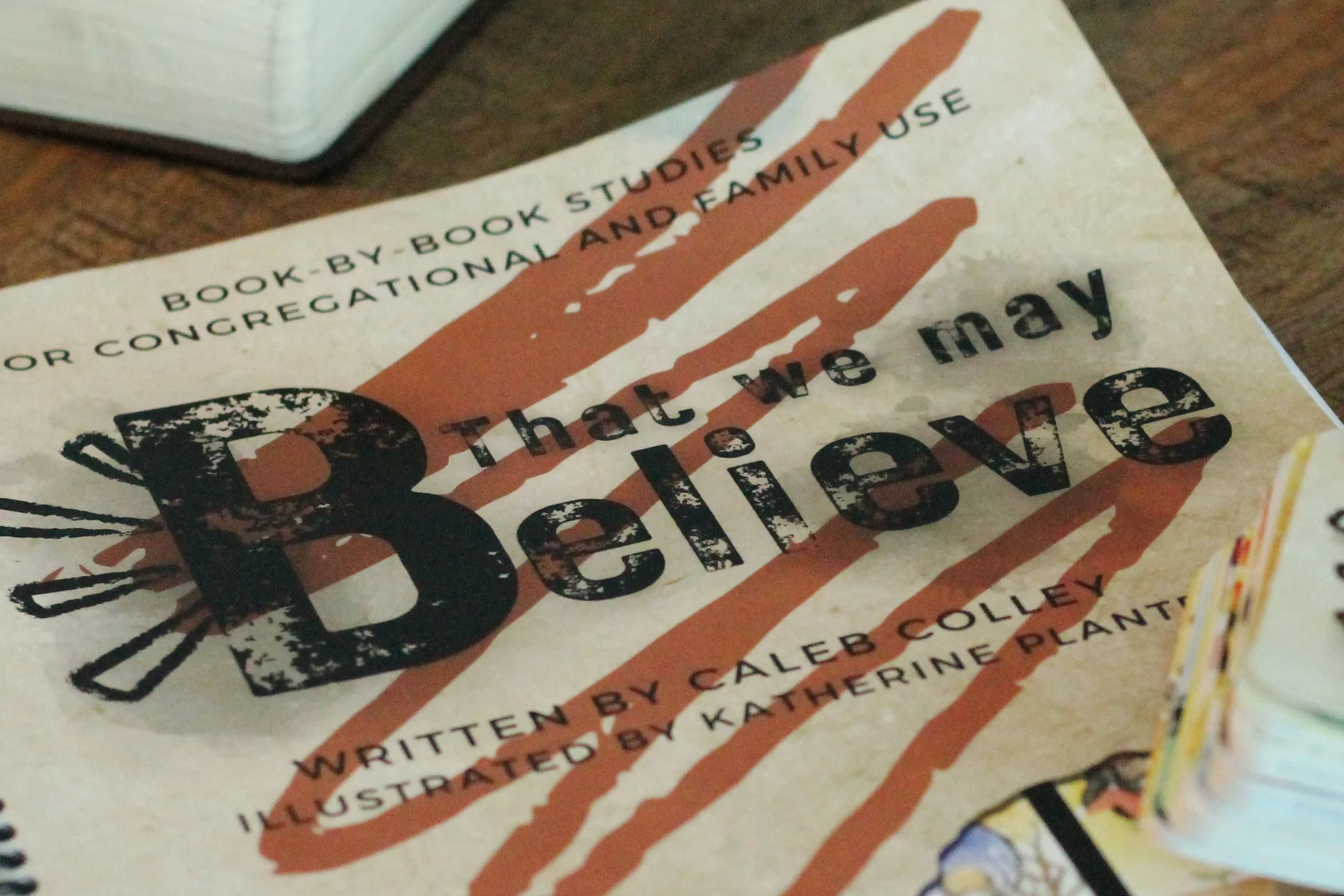
It’s been one of the sweetest, encouraging, most grounding parts of our homeschool days — and it works beautifully for multiple ages, whether you’re teaching several children, studying alongside your spouse, or even walking through Scripture on your own.
I was so excited when my friend told me that this study was coming out! We had already been studying the themes of each book of the Bible and was thrilled to have this study to enhance our learning even more!
Morning Bible Time vs. Evening Family Bible Time
In our home, we actually do both morning and evening family Bible studies, and they serve different purposes.
Our evening family Bible time is often more relaxed and interactive. Sometimes it’s a short Bible story before bed, but many nights we love to keep the kids engaged with hands-on activities, Bible games, trivia, or movement-based learning. Evening time is about connection and engagement, especially when kids are tired and attention spans are short.
This year-long book-by-book study, though, happens in the morning for us, although you can do it whatever time of day works best for you!
Mornings are quieter. Hearts and minds are fresher. Starting our day in Scripture helps set the tone for everything that follows — homeschool lessons, responsibilities, and daily life. Placing Bible time before our schoolwork has helped us keep “first things first” without rushing or forcing it.
This isn’t the only way to do family Bible time — it’s simply what works best for us in this season.
Why a Book-by-Book Study Matters
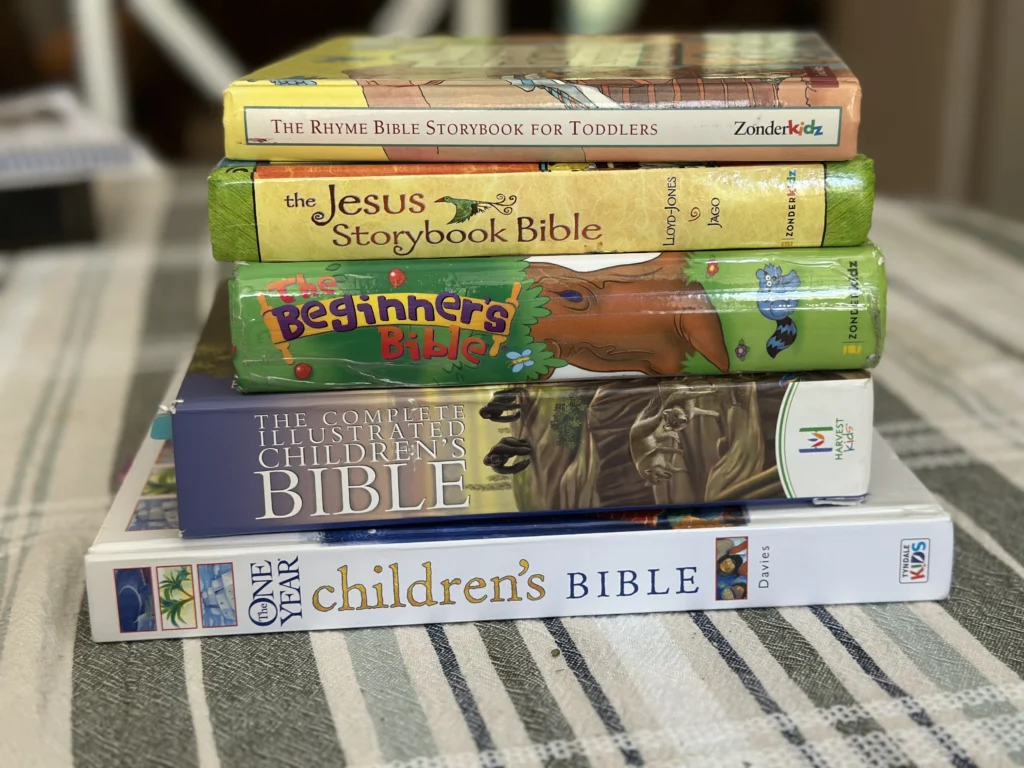
Last year we went through The One Year Children’s Bible. This children’s storybook as well as the the Children’s Illustrated Bible would be wonderful companions to have along side this Book-by-book study. Studying the Bible book by book has given our family a deeper understanding of Scripture as one connected story.
Instead of isolated lessons, our kids are learning:
- Who wrote each book
- The key themes of each book
- The type of book category it fits into
- Why it was written
- Where it fits in the overall timeline of Scripture
- What its main message is
They’re beginning to see patterns, themes, and God’s faithfulness woven throughout the entire Bible. And as adults, we’re growing right alongside them.
This approach builds a foundation — not just knowledge, but confidence in navigating God’s Word.
Why We Choose this Study
That We May Believe is a book-by-book Bible study designed to help families understand Scripture as one connected story. Rather than jumping from topic to topic, it walks through each book of the Bible with a clear structure that works beautifully for families with children of different ages.
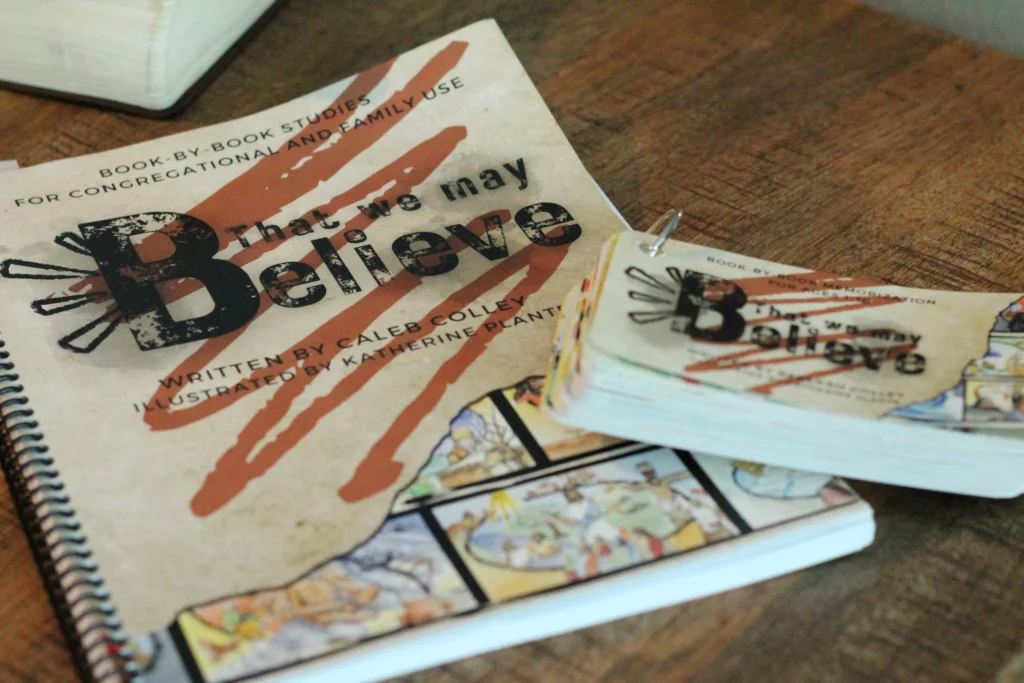
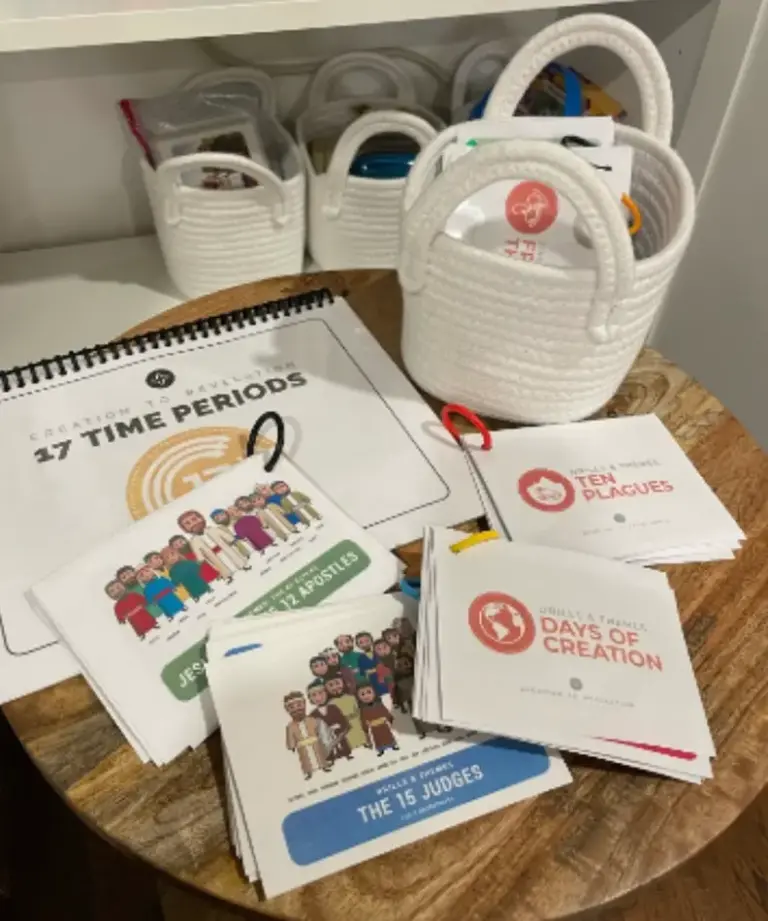
The study includes a main book that guides your daily lessons, along with memorization cards that introduce the author, theme, and category of each book. These cards have been especially helpful for our kids — the visuals give them something concrete to connect big ideas to.
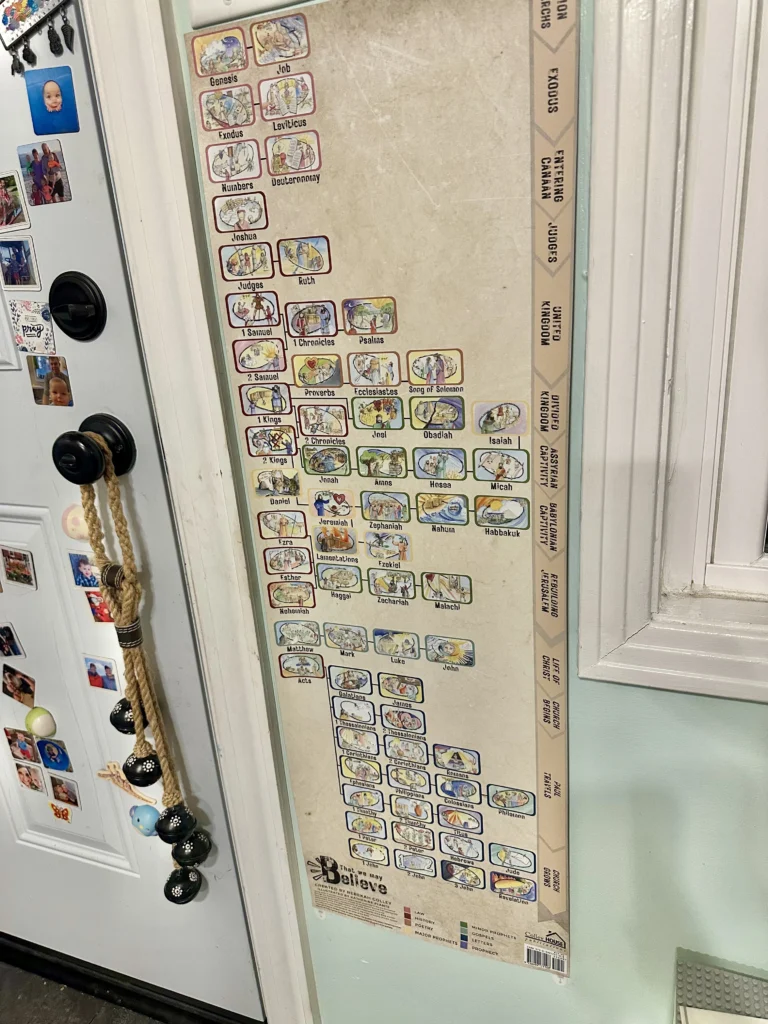
There’s also a Bible timeline, which helps place each book within the larger story of Scripture and has been invaluable for helping our children understand where they are in the Bible.
All of these pieces are available individually or bundled together, and there are digital options as well for families who prefer to print at home, use tablets, or have the option to print multiple to use in your home. No matter which format you choose, these Biblical resources support the same goal: helping families grow in God’s word and how to live our daily lives for Jesus Christ.
This study would also make a wonderful Bible lesson for new believers. Those who are new to living a Christian life often benefit from an organized, book-by-book approach that shows the overall picture of the Bible, beginning in the Old Testament and continuing through the New Testament. Rather than feeling scattered or overwhelmed, it offers a clear path through Scripture that builds understanding and confidence over time.
This post may contain amazon affiliate links, which means I may make a small commission at no extra cost to you. When you make a purchase through my link, you help me to keep Little Tennessee Home up and running! Thank you for your support! See my full disclosure here.
How We Structure Our Morning Family Bible Time
Our mornings follow a simple, predictable flow. Having a rhythm helps everyone know what to expect and makes it easier to show up consistently, even during hard times.
Scripture Writing to Begin the Day
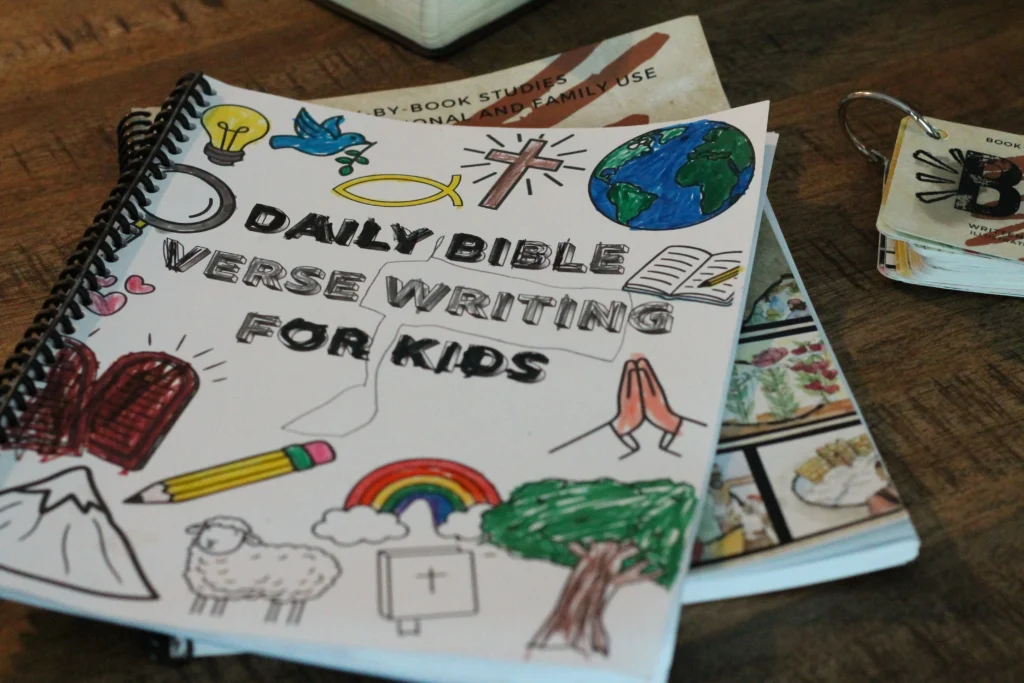
We always start with scripture writing, and it has become one of my favorite parts of our morning. We use key verses straight from the study and they double as memory verses towards their centurion of scripture memorization for Lads to Leaders!
- Older kids write the weekly memory verse (print or cursive)
- Younger children trace the verse
- Toddlers color a Bible themed picture or sticker dot pages
- These pages go into their morning tubs, so they can begin working independently
To make this feel special (and not like busywork), we use erasable ink pens or markers, which instantly makes kids more excited to participate. Writing the verse slows us down and helps the words sink in before we even begin discussion.
This step works beautifully for mixed ages and sets a calm, focused tone for the day.
Weekly Memory Verse
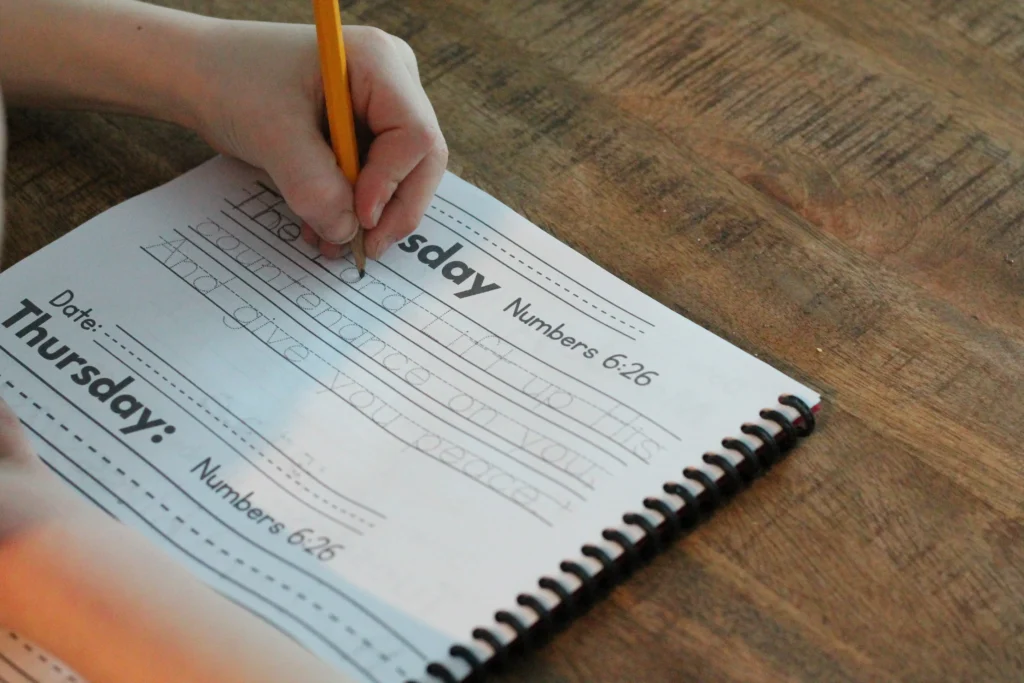
After scripture writing, we say the memory verse together. Sometimes we repeat it several times, sometimes we add hand motions, and sometimes we simply say it once and move on.
We choose two key verses each week from the study, keeping memorization manageable and meaningful.
Here is a suggestion for how to work on memory verse writing for kids:
Monday-Trace the first verse
Tuesday-Write the first verse agin without tracing
Wednesday-Trace the second verse
Thursday-Write the second verses again without tracing
Friday-Complete both verses “fill in the blank style”
Memorization Cards: Big Picture Learning
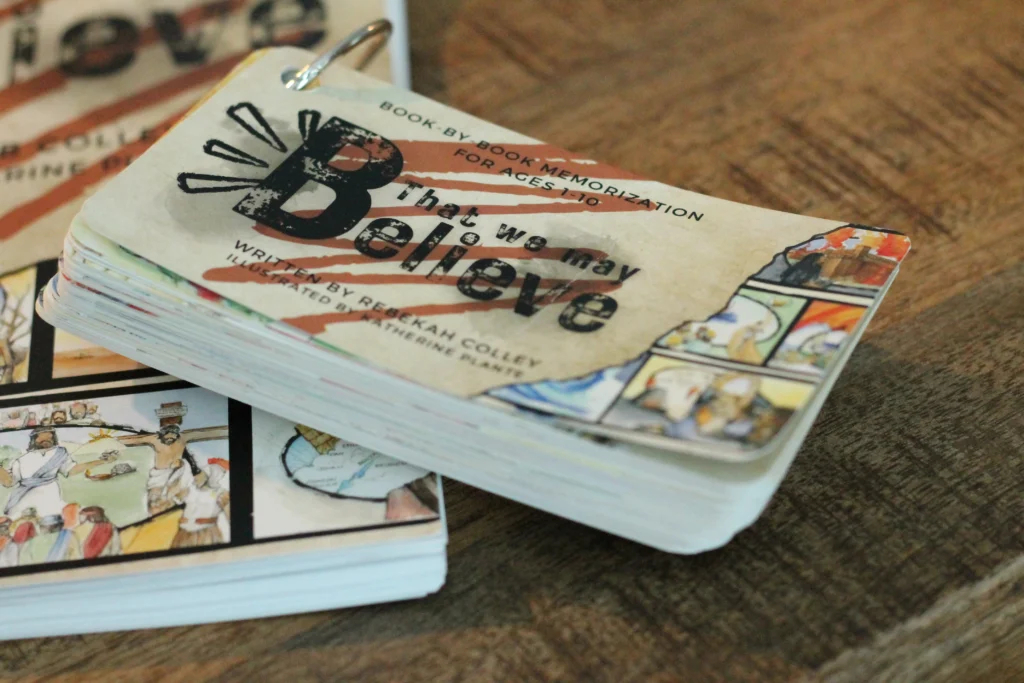
Next, we review the memorization cards from That We May Believe. These cards help us learn:
- The author of the book
- The theme or main idea
- The category of the book (Law, History, Poetry, Prophets, Gospels, Epistles, etc.)
The illustrations are beautiful and incredibly helpful for children. They provide visual anchors that help kids grasp the overall message and major events of each book, even when the text itself feels big.
Key Events, Reading, and Discussion
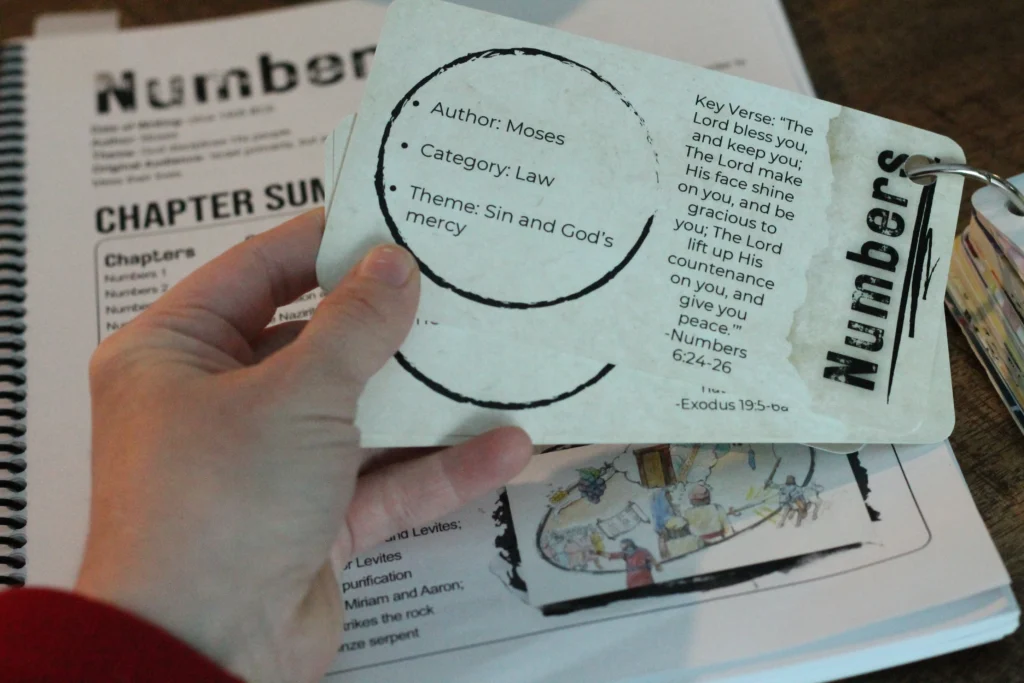
After reviewing the cards, we move into the key events of the book.
I’ll read aloud:
- The discussion starter for the day from the study, sometimes paraphrasing depending on the complexity of the question.
- Then guide conversation using age-appropriate questions
Some days spark great discussion. Other days are short and simple and both are valuable.
When it comes to reading:
- If the passage is short, we read directly from the Bible
- If we’re covering several events or a longer narrative, we use our favorite Children’s Illustrated Bible
Our storybook Bible presents Scripture in a way that’s easier for children to understand, while still staying faithful to the text. It allows younger kids to follow along and grasp the big ideas without feeling overwhelmed.
How We Adapt the Study to Our Homeschool Schedule
That We May Believe is laid out to be completed on specific days of the week:
Monday, Tuesday, Thursday, Friday, and Saturday.
For our family, we’ve chosen to adapt that structure to fit our homeschool rhythm.
We do:
- Monday–Friday
- In the morning
- Before homeschool lessons begin
Doing it this way is important to me to show my children that we start our day with the most important thing-time with God’s word. One of the things I appreciate most about this resource is that it’s structured, but not rigid.
You can absolutely adjust it to fit your family. From my understanding is that it was laid out that way to exclude Wednesday and Sunday nights when you’d be at worship, typically too late for a structured Bible time. Instead you could review the learn information from the pervious day or have each family member share something they learned at worship or Bible class that day. This is a great activity to do on the ride home.
There’s no single “right” schedule. The only “right way” is to make sure you are daily spending time in God’s word.
Don’t Feel Overwhelmed or Discouraged
If family Bible time feels intimidating, start small. Choose a time, a place, and choose consistency over perfection.
This year-long study has removed decision fatigue for us, given us a clear path through Scripture, and helped make Bible time something we genuinely look forward to.
Whether you’re studying with young children, older kids, your spouse, or on your own, the goal remains the same: opening God’s Word regularly and allowing it to shape your home, one day at a time.
Little by little, those moments add up and they matter more than we often realize.
Family Bible Time FAQ
What ages does this work for?
This rhythm works well for a wide range of ages. Younger children can participate through scripture tracing, listening, pictures on the memorization cards, and children’s Bible stories. Older children benefit from writing the verse, answering discussion questions, and connecting themes across books. Adults grow alongside them through discussion and big-picture learning. The same structure also works beautifully for just husband and wife or for individual study. See detailed suggestions for each age group below.
Would this work well for a Bible class?
Yes! This same structure would also work well for small groups, a small group leader, or even a Sunday school teacher looking for a clear, big-picture Bible study approach. There is a special bundle for congregational use.
How long does morning Bible time usually take?
Most mornings, our Bible time lasts 15–30 minutes, depending on the day and the discussion. Some days are shorter and simple; other days naturally invite more conversation. Flexibility is key — consistency matters more than length.
What materials do you need?
You don’t need much to get started:
- A Bible
- That We May Believe study and memorization cards
- Optional: Weekly scripture writing pages (printable or handwritten)
- Erasable pens or markers (optional, but highly motivating!)
- A children’s storybook Bible for younger listeners
Everything else can be added or adapted based on your family’s needs and season.
Do you have to follow the study exactly as written?
Not at all. While the study provides a helpful structure, it’s designed to be flexible. You can adjust the days, pace, and reading methods to fit your family’s schedule. The goal isn’t to check boxes — it’s to engage with Scripture consistently and meaningfully.
How to Use This Study with Different Ages
One of the things I appreciate most about a book-by-book study like That We May Believe is how adaptable it is. The structure stays the same, but the expectations shift depending on the season of life you’re in.
Here’s how this same study can work for different ages — without adding pressure or extra prep.
How to Do This Family Bible Study with Toddlers (Ages 1–3)
With toddlers, participation looks very different — and that’s okay.
At this age, the goal isn’t understanding timelines, authorship, or themes. The goal is exposure.
For toddlers, Bible time often looks like:
- Sitting nearby while an older sibling reads scripture
- Looking at the pictures on the memorization cards
- Learning the books of the Bible and reciting them
- Listening in short bursts during discussion
- Repeating key words during a lesson
- Hearing Bible stories read aloud from a storybook Bible that go along with the lesson
- Watching parents and siblings engage with God’s Word
- Singing worship songs
They may not understand it all but they will pick up on something. During longer discussions toddlers can play quietly with Bible related figurines or felt boards. Simply being present while Scripture is read and discussed is laying a foundation.
My two year old knows that we always do nightly Bible time before bed and if we ever switch up the routine and try to brush teeth first she will say “but we not do Bible time!” Children are so much more capable of learning at an early age then we give them credit for. Creating a routine for them early on will only help them continue this routine later on in life.
How to Do This Family Bible Study with Elementary-Age Kids
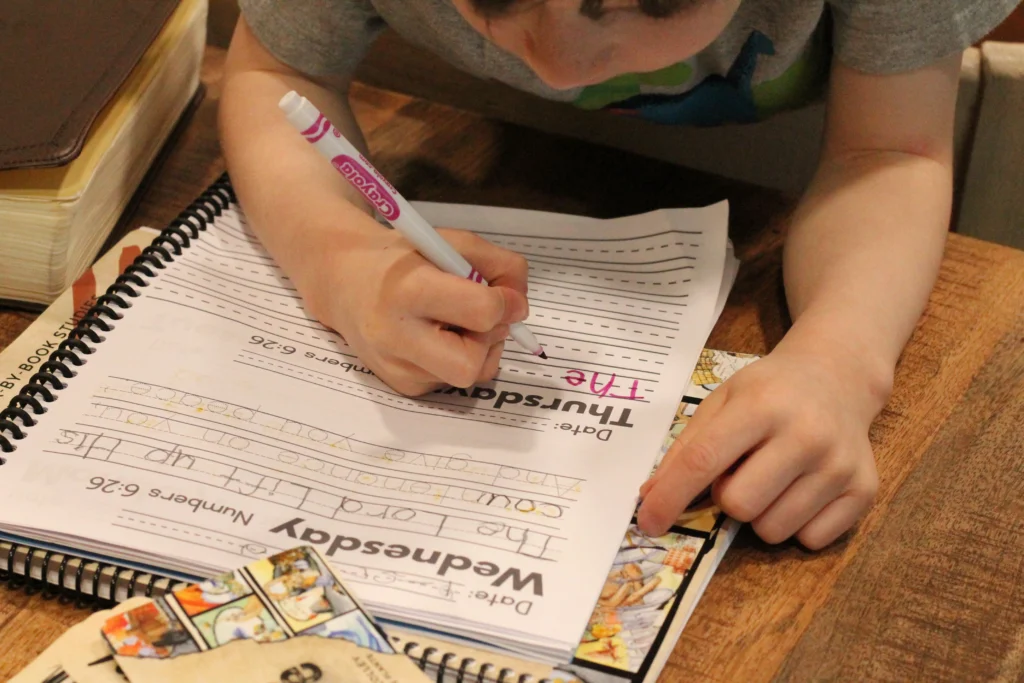
Elementary-age children are often the sweet spot for this type of study.
They can:
- Trace or write the weekly memory verse
- Begin memorizing scripture through repetition
- Identify authors, themes, and book categories
- Answer simple discussion questions
- Make connections between stories and real life
At this stage, visuals are incredibly helpful. The memorization cards and storybook Bible readings give kids something concrete to attach big ideas to. While some may not enjoy trivia style questions, it’s a great way to ask questions while having fun. I’ll talk more about Bible time activities and games in another post.
How to Do This Family Bible Study with Middle Schoolers and Teens
While I am not a mom of middle schoolers and teens yet, I’m confident that if you have built a firm foundation and a routine from an early age, that as kids grow, the study grows with them.
Middle schoolers and teens benefit from:
- Writing scripture independently
- Reading directly from the Bible more often
- Discussing why a book was written and who it was written to
- Wrestling with harder questions
- Seeing how individual books fit into the larger story of Scripture
This age thrives on conversation. Allow room for questions, uncertainty, and discussion. You don’t need to have all the answers — modeling how to thoughtfully engage with God’s Word, looking up answers and teaching those tools is just as valuable.
How to Do This Study as an Adult
This study isn’t just for children — it’s deeply enriching for adults as well.
Whether you’re:
- Studying alongside your children
- Doing this as a husband and wife
- Or walking through Scripture on your own
A book-by-book approach helps adults slow down, see Scripture as a whole, and grow in confidence navigating the Bible. The themes, structure, and memorization elements provide clarity without feeling overwhelming.
In many ways, this study has shaped our understanding just as much as our children’s.
A Final Encouragement
No matter the age, the heart of family Bible study stays the same: showing up consistently and opening God’s Word together.
Some days will feel focused and fruitful. Others will feel distracted and imperfect. Both still count.
This study works not because it’s complicated — but because it’s steady, intentional, and rooted in Scripture. And over time, those small, faithful moments begin to shape hearts in ways we can’t always see right away.